A Professional’s Perspective on Its Flaws and Limitations
Photo restoration is more than just fixing a damaged image, it’s about preserving history, memories, and authenticity. With the rise of AI-powered restoration tools, many assume that technology can now fully replace human expertise. AI can indeed restore old photos in seconds, but the real question is: is it restoring them correctly?
While artificial intelligence offers efficiency, it often falls short in understanding the nuances, emotions, and historical accuracy that a human restorer instinctively considers. In many cases, AI introduces distortions, alters facial features, and leaves behind artifacts that make a once-authentic image feel artificial. Before trusting AI with your most cherished photos, it’s crucial to understand its flaws, limitations, and why human expertise remains irreplaceable.

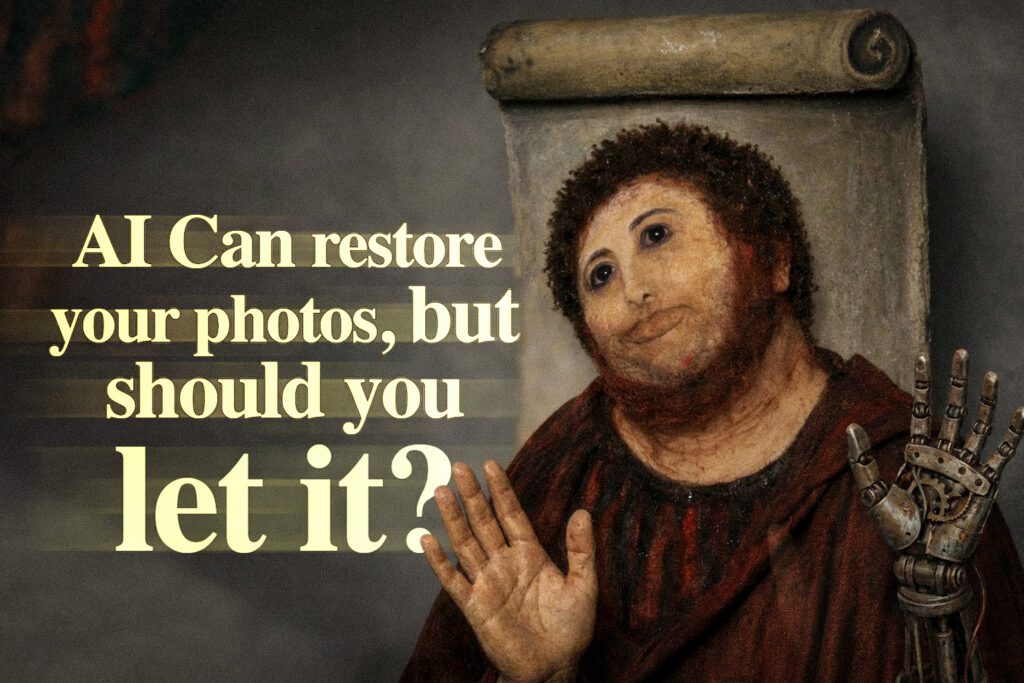
This example is based on the Ecce Homo restoration case with respect and care as a tribute to Cecilia Giménez. Beyond the technical discourse that followed her intervention, we acknowledge and believe that her actions were rooted in devotion, kindness, and a sincere desire to preserve what mattered to her community. The global attention that emerged from her work ultimately contributed to the restoration and preservation of her church, creating a cultural legacy far greater than the image itself. This reference is not an act of critique, but of acknowledgement. It reminds us that restoration is always human before it is technical, and that intention, context, and care matter as much as outcome.
How accurate is AI-based photo restoration compared to manual editing?

Accuracy depends on what is meant by accurate.
AI based photo restoration and manual editing solve different problems. These methods may overlap today, but they are not equivalent.

AI photo restoration is probabilistic reconstruction. The system analyses patterns learned from millions of images and predicts what should be there. This works extremely well for generic structures such as skin texture, hair density, edges, contrast recovery, and noise reduction. It is fast, consistent, and scalable. It is also indifferent to historical truth. When information is missing, AI invents. Faces are the most obvious example. Teeth, eyes, wrinkles, hairlines, uniforms, jewellery, and even facial expressions can be subtly or dramatically altered. The result often looks convincing but may be false.
Manual photo restoration is interpretive reconstruction constrained by evidence. A skilled restorer works from the actual photographic data, historical context, period references, material ageing patterns, and an understanding of optical and chemical processes. Damage is repaired, not reimagined. Texture is rebuilt cautiously. Tonality is balanced with intent. Identity is preserved. This takes time and judgement. It cannot be automated because each image is a specific object with a specific history.
If accuracy means visual plausibility on a phone screen, AI often wins.
If accuracy means fidelity to the original subject, era, and physical photograph, manual editing wins decisively.
Today the strongest workflows are hybrid. AI is used as a tool inside professional environments such as Adobe Photoshop to accelerate repair, rebuild texture, or stabilise degraded areas. A human then corrects AI hallucinations, restores intent, and makes final decisions. AI becomes a brush, not the painter.
For archival, heritage, or family legacy work, AI alone is insufficient. It produces attractive images that can quietly rewrite history. Manual restoration, with restrained AI assistance, produces slower results that remain truthful to the memory embedded in the photograph.
The Rise of AI in Photo Restoration

AI-driven photo restoration tools have surged in popularity, with platforms using advanced neural networks like Convolutional Neural Networks (CNNs) and Generative Adversarial Networks (GANs) to repair scratches, reduce noise, and enhance details. These tools are trained on vast datasets to “predict” missing information and reconstruct degraded images.
At first glance, AI restoration appears remarkably effective, often delivering crisp, clear images in seconds. But beneath the surface, it relies on algorithmic guesswork rather than true restoration. AI doesn’t “see” an image the way a human does, it processes patterns and probabilities, meaning that when it fills in missing details, it isn’t restoring what was originally there, it’s actually inventing something new.
The Shortcomings of Artificial intelligence in Photo Restoration

AI based restoration is not conservation. It is substitution masked as repair.
While it presents itself as a magic fix, it routinely alters images in ways that are subtle enough to go unnoticed yet significant enough to change meaning, identity, and historical truth.
When faced with missing or degraded information, AI does not pause or defer judgement. It predicts. Facial features are normalised, expressions are softened, textures are homogenised, and period specific imperfections are removed.
The result is often visually pleasing but structurally false. Much like the Ecce Homo restoration, the damage is not the caricatured outcome but the irreversible overwrite of original information.
AI cannot distinguish between loss and intention, between damage and ambiguity. Without human restraint, it does exactly what it is designed to do: complete the image, even when completion is the wrong choice.
AI-based restoration is not While AI seems like a magic fix, it frequently alters images in subtle yet significant ways. Here are some of the most common mistakes AI makes in photo restoration:
1. Halos & Ghosting

Halos and ghosting are artefacts produced by how generative and enhancement models infer structure rather than measure it.
Halos appear when an AI model aggressively separates subject from background. During edge enhancement, denoising, or upscaling, the model boosts contrast around perceived boundaries such as faces, hairlines, shoulders, or silhouettes. Because it does not truly understand depth or material transitions, it overcompensates. The result is a luminous outline or glow that does not belong to the original image. In restoration, this often appears around heads, facial contours, or high contrast edges and immediately signals synthetic intervention.
Ghosting occurs when the model averages multiple internal predictions of the same feature. AI systems generate images probabilistically. When confidence is low, especially in degraded areas, the model may partially retain earlier guesses while introducing new ones. This creates doubled edges, soft duplicates of facial features, or faint secondary outlines. In portraits, this is most visible around eyes, mouths, noses, and jawlines, where identity should be most stable.
Both issues emerge from the same limitation: AI completes images by prediction, not observation. It does not know which details must remain unresolved, nor which imperfections are historically valid. When tasked with restoration, it prioritises visual continuity over evidentiary restraint. The image looks cleaner, but less true.
In heritage photo restoration contexts, halos and ghosting are not minor defects. They are visual proof that the original information has been replaced by approximation. Once introduced, they obscure what was actually there, making later corrective restoration more difficult or impossible.
2. Texture Mismatches

Fabric, skin, and hair should have natural variations in texture. AI-generated restorations often create synthetic-looking patches that feel unnatural or overly smooth.
This image shows four distinct texture mismatches that are characteristic of AI generated or AI restored imagery. They are subtle in isolation but decisive when read together.
First, hair to skin transition failure. The beard and hair fibres dissolve unnaturally into the skin instead of emerging from follicles. Real hair has directional continuity and rooted density. Here it appears airbrushed and pasted, with no consistent growth logic.
Second, skin grain inconsistency. The cheek and neck areas show competing textures at different scales. One zone appears over smoothed and wax like, while adjacent areas show coarse, painted noise. Human skin maintains a coherent pore rhythm across planes, even when aged or damaged. This image does not.
Third, fabric to skin blending error. The robe texture bleeds upward into the neck area without a clean material boundary. Cloth and skin have radically different reflective behaviour. AI often merges them when confidence drops, producing a muddy intermediate texture that belongs to neither.
Fourth, lighting and material contradiction. Highlights suggest a soft studio light, yet micro texture reacts as if under diffuse ambient illumination. The result is a surface that reflects light but does not obey physical light falloff. This mismatch is a strong indicator of synthetic reconstruction.
3. Unnatural Facial Reconstructions

One of AI’s most persistent weaknesses is the human face. Faces carry identity, emotion, age, and history in a way no other subject does, yet AI does not understand faces as lived structures. It recognises patterns and averages them. When restoring damaged images, this often leads to subtle but profound distortions.
Expressions are frequently misread. Neutral faces are softened into faint smiles. Fatigue becomes calm. Seriousness turns pleasant. Eyes are enlarged or over clarified, eyelids lose structural depth, and gaze becomes artificially intense. Defining asymmetries that make a face recognisable are smoothed away in favour of symmetry and balance. The person remains, but their individuality fades.
The danger is not grotesque failure. It is the uncanny. The image looks believable, even improved, yet something essential has shifted. What was once a real individual becomes an AI idealised approximation. In restoration, this is critical. Altering a face alters identity. Without human judgement to preserve expression, proportion, and imperfection, AI reconstruction risks turning memory into simulation rather than preservation.
4. Over-Smoothing (Plastic Skin Effect)

One of AI’s biggest weaknesses is human faces. It often misinterprets expressions, leading to exaggerated smiles, distorted eyes, or a loss of defining facial characteristics, turning a real person into an uncanny, AI-generated version.
Over smoothing occurs when AI prioritises noise reduction and visual cleanliness over material accuracy. In degraded images, the model interprets fine detail as noise and removes it indiscriminately. Skin becomes uniform, waxy, and reflective. Wrinkles collapse into soft gradients. Lip texture loses its fibrous structure and turns rubber like. These changes are often marketed as improvement, but they fundamentally alter the subject.
The danger lies in subtle acceptance. At normal viewing size, the image looks polished and modern. Under inspection, it no longer behaves like skin. Over smoothing does not restore what time has damaged. It replaces it with a synthetic surface optimised for aesthetic appeal rather than historical or personal truth. In restoration, this is not care. It is cosmetic erasure.
5.Temporal inconsistency.

AI does not respect time. It blends features from different eras, materials, and processes into a single image.
A nineteenth century photograph may inherit twentieth century skin texture, modern cosmetic lighting, or contemporary facial aesthetics. The image looks coherent, but it no longer belongs to its time.
AI reconstructs faces using dominant patterns from its training data. This can subtly shift ethnicity, age markers, class indicators, or regional traits. Facial structure, grooming, skin tone balance, and expression drift toward statistical norms rather than the subject’s actual identity. This is not neutral error. It is systemic distortion.
In this image, the eyes are reconstructed using modern visual priors. They resemble contemporary high resolution digital photography, with clean reflections, sharp contrast, and cosmetically enhanced definition. The surrounding face, hair, and background behave like aged material. These elements do not belong to the same photographic moment.
This mismatch is subtle but profound. Eyes are the strongest carriers of identity and time. When they drift forward technologically while the rest of the image remains anchored in the past, the subject becomes temporally impossible. The person did not exist like this at any point in history.
Human restorers correct damage while preserving era. AI restores parts independently, optimising for plausibility rather than coherence. Temporal inconsistency is not a visible glitch. It is a historical one.
6. Loss of Depth and Contrast

Depth in photography comes from controlled contrast. Light and shadow describe form, distance, and material. AI models often compress tonal range in pursuit of smoothness and visual consistency. Shadows are lifted to avoid noise. Highlights are restrained to prevent clipping. Midtones dominate.
The result is an image that feels clean but spatially hollow. Cheekbones lose contour. Eye sockets flatten. Jawlines dissolve into surrounding tones. The subject no longer occupies space convincingly. This is not a stylistic choice. It is a byproduct of optimisation.
In restoration, this matters deeply. Depth carries identity. Contrast preserves structure. When AI neutralises both, it does not simply improve clarity. It removes dimensional truth. What remains is a plausible surface without the physical reality that once anchored the image in time and space.
AI restoration often flattens an image, failing to preserve the depth and contrast between light and shadows. This results in photos that lack dimension and feel lifeless.
7. Digital Artifacts and Noise

Instead of fully restoring damaged areas, AI sometimes creates digital noise, pixelation, or strange patterns, making the final image feel unnatural.
In traditional photography, noise and grain are the result of physical processes: film chemistry, sensor behaviour, exposure limits, or ageing materials. They follow consistent patterns tied to light, surface, and capture technology. AI generated noise does not. It appears where the model is uncertain.
When AI encounters ambiguous textures, such as damaged hair, degraded backgrounds, or transitional edges, it fills the gap with statistically plausible noise. This produces clumped grain, crawling artefacts, and debris like textures that shift scale unpredictably. The noise does not belong to the image’s era, medium, or material. It belongs to the model’s uncertainty.
These artefacts are often mistaken for authenticity because they look rough or aged. In reality, they obscure original information and replace it with synthetic texture. For restoration work, this is critical. Once digital artefacts are introduced, they mask what was truly there, making future conservation harder. Noise created by time tells a story. Noise created by AI tells you the model did not know what to do.
8. Hallucinated Details

AI hallucination occurs when a model fills gaps in degraded or incomplete images with fabricated detail rather than verified information.
Unlike a human restorer, AI cannot distinguish between what is missing, what is damaged, and what was never there. When confidence drops, the system compensates by inventing plausible features drawn from its training data. Extra hair is added, facial anatomy is subtly reshaped, expressions are softened or altered, and textures are normalised to match learned patterns rather than historical evidence.
These hallucinations are especially dangerous because they are not obvious errors. The image looks better, clearer, more human. But authenticity has been compromised. Identity shifts quietly. What survives is not the past, but a statistically convenient version of it. In restoration, this is not enhancement. It is replacement.
These flaws may not be immediately obvious, but when viewed closely, they significantly impact the authenticity of a restored image.
AI can “hallucinate” details that never existed in the original photo, adding extra hair, altering facial proportions, or filling in missing areas with fabricated data instead of true historical accuracy.
These flaws may not be immediately obvious, but when viewed closely, they significantly impact the authenticity of a restored image.
9. "Hands" AI’s Biggest Weakness in Photo Restoration

While AI has revolutionised photo restoration, one of its most persistent and noticeable failures is in restoring hands correctly. Unlike facial features, which AI models prioritise, hands are complex, highly variable, and often overlooked in AI training datasets. This leads to frequent distortions, missing fingers, unnatural positioning, and plastic-like textures. all of which can ruin an otherwise well-restored image.
Hands are uniquely difficult for generative models because they combine complex anatomy, high variability, and strict spatial logic. Each hand contains multiple joints, overlapping planes, and subtle proportional rules that must remain consistent across perspective and motion. AI models do not understand hands as functional systems. They assemble them statistically from fragments seen during training.
Recent models have improved dramatically. Finger counts are more stable, proportions are closer to human norms, and gross deformities are less common than in earlier generations. However, hands remain a stress test for generative systems. Under close inspection, issues persist: fused fingers, incorrect joint rotation, inconsistent bone structure, and ambiguous material transitions.
In restoration and historical imagery, these errors matter. Hands carry identity, gesture, and meaning. When AI approximates them, it risks altering expression and intent. Progress is real, but the limitation remains clear. Until models understand anatomy rather than imitate it, hands will continue to reveal where generation ends and reconstruction begins.
Why Human Expertise is Still Essential

Despite AI’s rapid progress, restoring a photograph requires more than technology. It requires judgement, artistry, and historical sensitivity. A professional restorer approaches each image as a unique object, not as a dataset sample. Decisions are guided by evidence, not probability.
What makes human expertise irreplaceable is context. A trained restorer understands photographic processes, paper types, emulsions, lenses, lighting conventions, and period aesthetics. They recognise when a blur is intentional, when contrast was limited by the medium, when damage should be stabilised rather than corrected. They work incrementally, often non destructively, constantly checking that each intervention remains faithful to the original material.
Human restorers also apply restraint. They know when missing information should remain missing. They preserve identity by resisting beautification, symmetry correction, or emotional softening. They evaluate results holistically, not region by region, ensuring coherence across anatomy, texture, depth, and time.
AI can assist by accelerating repetitive tasks, isolating damage, or testing hypotheses. But without human oversight, it replaces truth with approximation. Professional restoration is not about producing the cleanest image. It is about preserving what actually existed, even when that truth is imperfect.
What Human Restorers Do That AI Can’t:

While AI can assist in the process, it should never be the final step. A professional restorer reviews, corrects, and fine-tunes AI-generated images to ensure they remain faithful to the original.
- Preserve True Facial Features: Ensuring loved ones still look like themselves.
- Maintain Natural Textures: Restoring fabric, skin, and hair accurately.
- Honour Historical Accuracy: Avoiding fabricated or incorrect details.
- Adjust Restoration Levels: Knowing when to stop before an image becomes over-processed.
- Work With Clients: Understanding the personal and historical value of an image and above all ai would never achieve: Real Human Empathy
The Importance of Client Collaboration
Unlike AI, human restorers engage in dialogue with their clients. Understanding the story behind a photograph, who the people are, the significance of the image, and its personal meaning allows for a more informed and thoughtful restoration.
When restoring a cherished family photo or a historical image, accuracy matters. A slight shift in a facial feature, an incorrect texture, or a loss of detail can alter the emotional impact of a photo. This is why professionals take the time to consult, analyse, and restore images with care and respect.
Should You Let AI Restore Your Photos?
AI is a powerful tool, but not a perfect solution. We integrate and embrace it within our workflow with one clear principle: it must serve history, not override it. Used carefully, AI can assist in early restoration stages by analysing damage, stabilising degraded areas, and reducing repetitive technical labour. It accelerates process, not judgement.
What AI cannot replace is discernment, emotional intelligence, and historical sensitivity. It does not understand context, intent, or identity. A skilled human restorer does. Every image is approached individually, with decisions guided by the original material, the photographic process of its time, and the responsibility of preservation.
If speed is the priority, AI alone may seem convenient. If authenticity matters, human expertise is essential. In our practice, AI is a brush, not the artist. It is a tool guided by a trained hand, used with restraint, and stopped where history must be respected.